


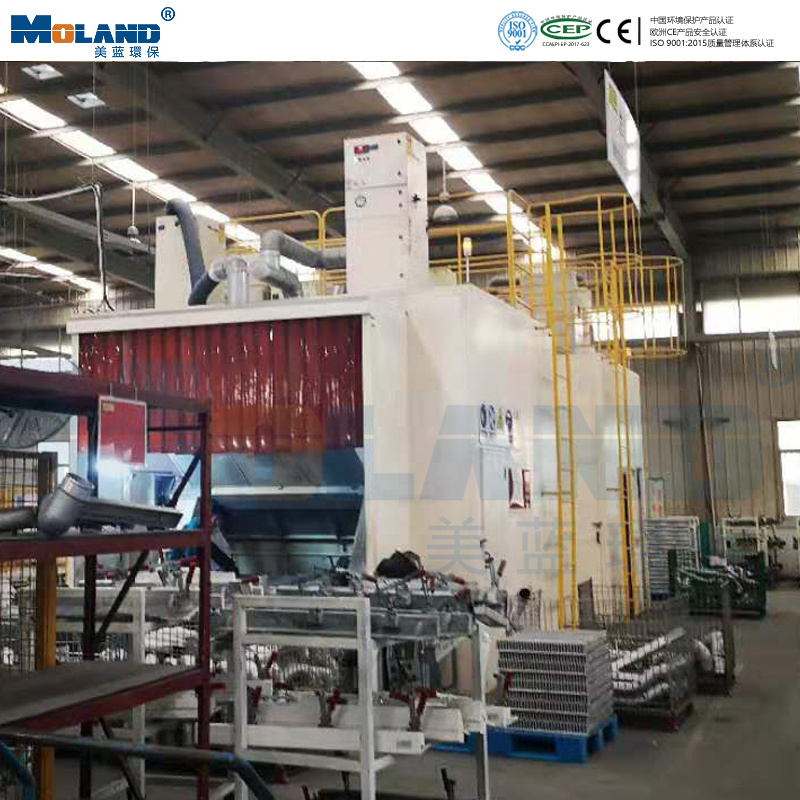
Welding booth Dust Collection — also called welding enclosures or welding rooms — are semi-enclosed or fully enclosed workstations designed to isolate welding operations from the surrounding workshop. Specifically, they serve two critical purposes. First, they contain welding fumes within a defined space, preventing fugitive emissions from spreading across the entire facility. Second, they provide welders with a dedicated, organized workspace with proper lighting, ventilation connections, and safety equipment.
However, a welding booth without proper dust collection quickly becomes a fume trap. Specifically, the enclosed structure prevents natural ventilation from dispersing contaminants. Consequently, fine particles — including manganese, hexavalent chromium, and iron oxide — accumulate to dangerous concentrations inside the booth. Moreover, without mechanical extraction, welders working inside the booth inhale concentrated fumes throughout their shifts. Therefore, every welding booth must be paired with a properly designed dust collection system to ensure safe working conditions and regulatory compliance.
The challenge intensifies in heavy manufacturing environments. Specifically, large workpieces generate sustained fume volumes over long welding cycles. Furthermore, multiple welding processes — MIG, MAG, TIG, and stick welding — may operate within the same booth. As a result, the dust collection system must handle variable fume loads while maintaining consistent capture efficiency. In addition, the system must integrate seamlessly with the booth structure without interfering with workpiece loading, welder movement, or crane operations.
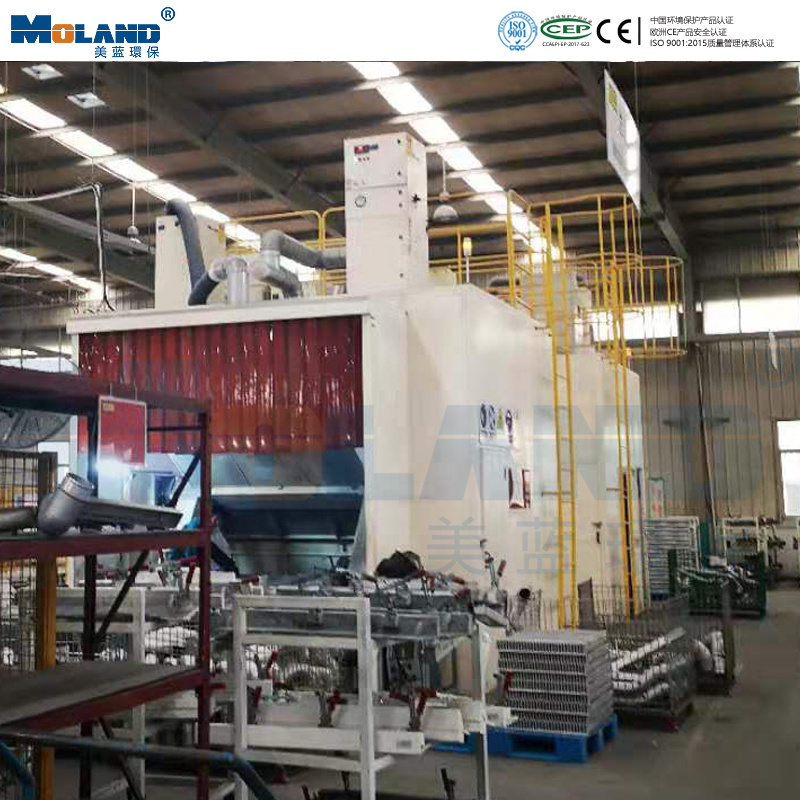
Understanding the different welding booth configurations helps determine the optimal dust collection approach. Specifically, each booth type presents unique airflow and capture challenges.
Open-front booths feature three enclosed walls and a roof, with the front face open for workpiece access. Specifically, this design allows overhead cranes to load large workpieces from the front. Moreover, the open face requires careful airflow management to prevent fume escape. Therefore, dust collection systems for open-front booths typically employ cross-draft or down-draft airflow patterns. Furthermore, the extraction capacity must be higher than fully enclosed designs to compensate for the open face.
Fully enclosed booths have four walls, a roof, and access doors or roll-up curtains. Specifically, this configuration provides the highest level of fume containment. Moreover, the sealed environment allows lower air volumes to achieve effective fume control. Consequently, fully enclosed booths are ideal for robotic welding cells and automated processes. Additionally, the sealed structure enables filtered air recirculation, eliminating the energy loss associated with exhausting conditioned air.
Drive-through booths allow workpieces to enter from one side and exit from the other. Specifically, this design suits production-line welding where workpieces move through multiple stations. Furthermore, the linear airflow pattern — entering from one end, exiting from the other — naturally directs fumes toward the extraction point. Consequently, drive-through booths are common in structural steel fabrication and pipeline welding shops.
Effective fume extraction inside a welding booth depends on three airflow design principles. Specifically, these principles ensure that fumes are captured before reaching the welder's breathing zone.
The extraction system must generate sufficient capture velocity at the welding arc to overcome thermal buoyancy and cross-drafts. Specifically, welding fumes rise at velocities of 0.5 to 1.5 meters per second due to thermal convection. Moreover, cross-drafts from operator movement, crane operations, and workshop ventilation create additional interference. Therefore, the capture velocity at the fume generation point must exceed 1.0 m/s to ensure reliable fume capture under all operating conditions.
The booth's airflow path must direct captured fumes away from the welder's breathing zone and toward the extraction outlet. Specifically, the ideal airflow pattern moves clean air past the welder first, then through the welding zone, and finally into the extraction duct. Furthermore, this clean-to-dirty airflow sequence prevents fumes from crossing the welder's face during operation. Consequently, booth designers position extraction outlets on the opposite side from the operator's standing position or above the welding zone for down-draft configurations.
The total air volume must provide sufficient air changes per hour (ACH) to maintain acceptable fume concentrations inside the booth. Specifically, welding booths typically require 40 to 80 air changes per hour, depending on the welding process intensity and fume generation rate. Moreover, heavier processes such as flux-cored arc welding (FCAW) and carbon arc gouging demand higher ACH values. Therefore, the dust collection system's air volume must match the booth volume and the expected fume generation rate.
A leading heavy machinery manufacturer in Shandong Province operates a large fabrication facility producing excavator boom arms, bucket frames, and undercarriage components. Specifically, the facility houses eight welding booths — four open-front booths for manual welding and four fully enclosed booths for robotic welding. The workpieces range from 500 kg to 8 tons, with welding cycles lasting 2 to 6 hours per piece.
Before installing the new dust collection system, the facility experienced several serious issues:
In short, the existing dust collection approach was inadequate for the facility's production intensity and fume generation volume.
After conducting a comprehensive on-site assessment — including booth dimensions, welding process analysis, workpiece handling patterns, and workshop layout — MoLAND designed an integrated welding booth dust collection system. Specifically, the solution comprised two subsystems: a centralized duct network serving the four open-front booths, and four independent extraction units for the robotic welding booths.
For the four open-front manual welding booths, MoLAND implemented a cross-draft airflow configuration. Specifically, fresh air enters through the open front face, flows horizontally across the welding zone, and exits through extraction slots on the rear wall. Moreover, this horizontal airflow pattern effectively sweeps fumes away from the welder's breathing zone before thermal buoyancy can carry them upward.
表格
| Parameter | Specification |
|---|---|
| Booth Dimensions | 5m (W) × 6m (D) × 4.5m (H) per booth |
| Airflow Pattern | Cross-draft (front-to-rear) |
| Extraction Air Volume | 12,000 m³/h per booth |
| Rear Wall Extraction Slots | 2 rows × 6m, each slot 200mm wide |
| Face Velocity at Open Front | 0.8 m/s |
| Central Host Unit | MLWF450 × 1 (shared by 4 booths) |
| Duct Diameter (Main Trunk) | φ630mm |
| Filter Type | PTFE membrane cartridge |
| Filtration Efficiency | 99.97% at 0.3μm |
| Pulse Cleaning | Automatic, PLC-controlled |
Furthermore, each booth is equipped with a manual butterfly damper, allowing operators to isolate inactive booths. Consequently, the centralized MLWF450 unit adjusts fan speed through a Siemens VFD based on the number of active booths. As a result, energy consumption drops significantly when only one or two booths are in operation.
For the four robotic welding booths, MoLAND designed a top-down extraction system. Specifically, extraction ducts are positioned at the ceiling of each booth, creating a downward airflow that pushes fumes away from the robot and toward floor-level exhaust grilles. Moreover, the fully enclosed structure minimizes air leakage, allowing precise airflow control. Additionally, each robotic booth has its own dedicated MLWF280FA-PLUS unit, providing independent operation and maintenance scheduling.
表格
| Parameter | Specification |
|---|---|
| Booth Dimensions | 4m (W) × 5m (D) × 3.5m (H) per booth |
| Airflow Pattern | Top-down (ceiling extraction + floor supply) |
| Extraction Air Volume | 5,000 m³/h per booth |
| Ceiling Extraction Ducts | 2 × φ315mm per booth |
| Floor-Level Supply Grilles | 4 per booth, evenly distributed |
| Dedicated Host Unit | MLWF280FA-PLUS × 1 per booth |
| Filter Type | PTFE membrane cartridge |
| Filtration Efficiency | 99.97% at 0.3μm |
| Control | Independent PLC per unit, pulse-jet auto-cleaning |
The customer required zero production downtime during installation. Specifically, MoLAND's engineering team executed the project in three phases, coordinating with the customer's maintenance schedule.
During the first phase, the team installed all ductwork, support structures, and extraction slots during scheduled weekend shutdowns. Specifically, galvanized steel ducts were prefabricated off-site and assembled on-site using modular flange connections. Moreover, rear-wall extraction slots were cut and fitted with adjustable dampers for airflow balancing. Furthermore, the main trunk duct was routed along the workshop ceiling to avoid interfering with crane operations.
The central MLWF450 unit was placed in the outdoor equipment yard, connected to the existing 380V power supply and compressed air system. Specifically, the PLC was programmed to communicate with the Siemens VFD, enabling automatic fan speed adjustment based on active booth count. Additionally, each robotic booth received its dedicated MLWF280FA-PLUS unit, installed adjacent to the booth exterior wall for minimal duct length.
The final phase included airflow balancing, system tuning, and performance testing. Specifically, MoLAND's engineers used professional particle counters and anemometers to measure fume concentrations and airflow velocities at multiple points inside each booth. Moreover, each booth was tested under maximum welding load conditions to verify design performance. Consequently, all eight booths passed the acceptance criteria on the first attempt.
表格
| Metric | Before | After | Improvement |
|---|---|---|---|
| PM2.5 inside manual booths | 800+ μg/m³ | 35 μg/m³ | 96% reduction |
| PM2.5 inside robotic booths | 520 μg/m³ | 18 μg/m³ | 97% reduction |
| Fume escape to workshop | Severe | Negligible | Virtually eliminated |
| Occupational health inspection | Failed | Passed with excellence | Full compliance |
| Filter replacement frequency | Every 4–6 weeks | Every 12–18 months | 10x longer life |
| Robot sensor contamination | Weekly cleaning | Zero incidents | 100% elimination |
| Welder health complaints | 20+ per month | 0 per month | Zero complaints |
| Annual filter consumable cost | ¥96,000/year | ¥18,000/year | ¥78,000 saved |
The total system investment was approximately ¥520,000, including equipment, ductwork, installation, and commissioning. Annual savings include:
Total annual savings: ¥373,000+. Payback period: under 17 months.
The cross-draft configuration was selected specifically for open-front booths because it leverages the booth's geometry. Specifically, fresh air enters from the open front, flows horizontally past the welder, and exits through the rear extraction slots. Moreover, this pattern ensures fumes never pass through the welder's breathing zone. Furthermore, the face velocity of 0.8 m/s at the open front prevents fume leakage into the surrounding workshop.
Robotic welding booths benefit from top-down extraction because robots operate at fixed positions with predictable fume generation patterns. Specifically, ceiling-mounted extraction ducts create uniform downward airflow, sweeping fumes from the welding arc toward floor-level exhaust grilles. Consequently, the robot and its sensitive sensors remain in clean air throughout the welding cycle.
Rather than using a single centralized system for all eight booths, MoLAND designed a hybrid architecture. Specifically, the four open-front manual booths share one central MLWF450 unit with VFD control. Meanwhile, the four robotic booths each have independent MLWF280FA-PLUS units. Moreover, this hybrid approach offers three advantages: first, it allows the manual booths to benefit from load-sharing and energy savings through VFD. Second, it gives robotic booths independent operation, so maintenance on one unit does not affect others. Third, it simplifies future expansion — additional robotic booths can be added without modifying the central system.
PTFE membrane cartridges were selected because welding fume contains sub-micron particles that clog standard filter media rapidly. Specifically, the PTFE membrane's smooth surface prevents deep particle penetration. Moreover, pulse-jet cleaning restores near-complete airflow recovery after each cleaning cycle. Consequently, the cartridges maintain consistent performance for 12 to 18 months before replacement is needed. Additionally, filtered air achieves indoor recirculation quality, eliminating the energy penalty of exhausting conditioned workshop air.
Open-front booths are prone to fume leakage when airflow design is inadequate. Specifically, insufficient extraction volume or incorrect slot positioning allows fumes to escape through the open face. Therefore, the solution is to ensure adequate face velocity (minimum 0.7 m/s) and position extraction slots at the correct height to capture the thermal plume before it reaches the booth opening.
Overhead crane operations are common in heavy manufacturing booths. Specifically, crane movement creates strong cross-drafts that disrupt extraction airflow patterns. Moreover, crane hooks and cables may collide with poorly positioned ductwork. Consequently, duct routing must be planned to avoid the crane's operating envelope. Furthermore, flexible duct sections or telescopic duct connections can accommodate crane passage without interrupting extraction.
Many workshops use the same booth for different welding processes — for example, MIG welding for thick sections and TIG welding for finishing passes. Specifically, each process generates different fume volumes and particle sizes. Therefore, the dust collection system must handle this variability without compromising capture efficiency. Moreover, variable-speed extraction with manual or automatic adjustment addresses this challenge effectively.
Heavy-duty welding processes such as submerged arc welding (SAW) and carbon arc gouging generate extremely high-temperature fumes. Specifically, these fumes can exceed 200°C at the source. Therefore, standard filter cartridges cannot withstand these temperatures. Consequently, high-temperature applications require specialized filter media or spark arrestors upstream of the filtration unit.
MoLAND designs and manufactures complete welding booth dust collection systems for heavy manufacturing, structural steel fabrication, and general metalworking applications. Specifically, our solutions include:
Every welding booth deserves a dust collection system that matches its operational intensity. The right design protects welder health, eliminates fume escape, and ensures environmental compliance — without disrupting production.
Contact MoLAND today for a free on-site booth assessment and custom dust collection design.

