


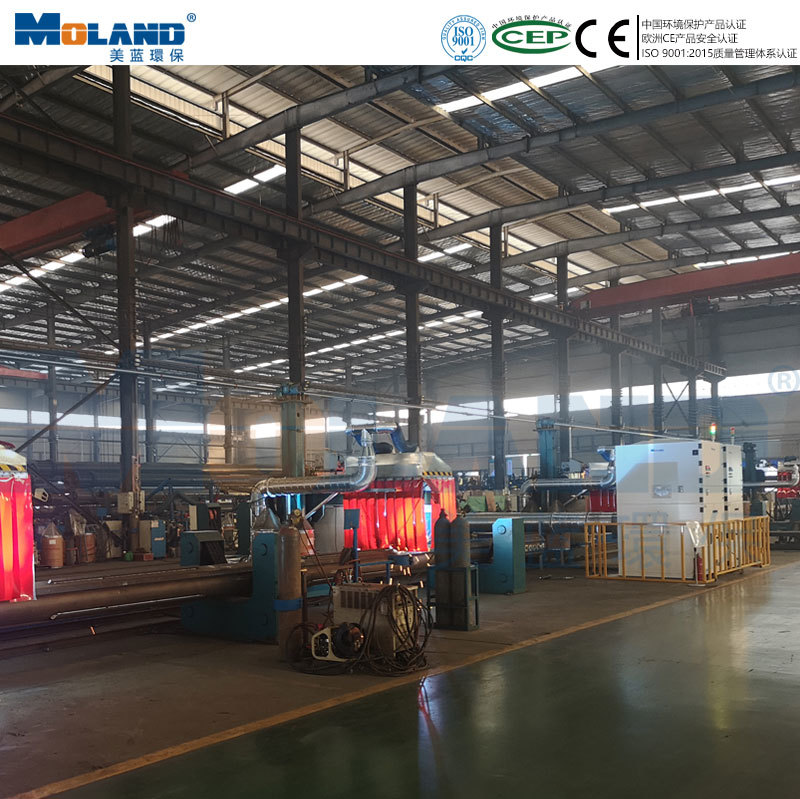
Hood-Suction Dust Collection Longitudinal seam welding machines — also called straight seam welders or longitudinal welders — are dedicated automated welding systems designed for joining the straight seam of cylindrical, conical, or box-shaped workpieces. Specifically, they are widely used in pressure vessel manufacturing, pipe fabrication, tank production, and structural tube welding. Moreover, these machines operate in a fundamentally different pattern from general-purpose welding stations: the welding torch travels in a continuous straight line along the entire seam length, or the workpiece rotates beneath a fixed torch.
This continuous, linear welding motion creates a sustained and predictable fume generation pattern. Specifically, as the torch traverses the seam — which may be 2 to 12 meters long — fume is produced steadily along the entire welding path. Furthermore, the welding processes commonly used for longitudinal seams — submerged arc welding (SAW), gas metal arc welding (GMAW/MIG), and flux-cored arc welding (FCAW) — generate substantial fume volumes, particularly when flux or filler wire is consumed. Consequently, the dust collection system must maintain consistent capture efficiency across the entire seam length without requiring repositioning during the weld cycle.
Traditional portable fume extractors or flexible suction arms are poorly suited for this application. Specifically, portable units lack the capture range to cover the full seam length. Moreover, flexible arms require manual repositioning as the torch moves — which defeats the purpose of automated welding. Therefore, a fixed hood-suction dust collection system designed specifically for the longitudinal seam welding machine's geometry and cycle is the most effective solution.
Different welding processes used on longitudinal seam welding machines produce distinct fume profiles. Understanding these profiles is essential for designing an effective hood-suction dust collection system.
Submerged arc welding is the dominant process for thick-wall pressure vessels and large-diameter pipes. Specifically, a granular flux covers the arc zone entirely, which suppresses visible fume and ultraviolet radiation. However, the flux still generates significant fine particulate emissions — particularly during flux melting and slag formation. Moreover, SAW on longitudinal seams operates at high deposition rates (10–30 kg/h), meaning fume is generated continuously over long durations. Consequently, the dust collection system must handle sustained fume loads of 3,000 to 8,000 m³/h depending on the number of torch heads.
MIG welding is common for thin-wall tubes, stainless steel tanks, and aluminum containers. Specifically, the process generates visible fume consisting primarily of iron oxide, manganese, and silicon compounds. Moreover, solid wire MIG produces less fume than flux-cored wire — but the fume is finer (sub-micron) and more readily disperses. Therefore, the hood-suction system must achieve high capture velocities to intercept fine particles before they escape the capture zone.
Flux-cored welding combines the high deposition rate of SAW with the visibility of open-arc processes. Specifically, the flux core generates heavy fume volumes with a mix of coarse and fine particles. Furthermore, FCAW on longitudinal seams often uses multiple torch heads for simultaneous welding from both sides of the seam. Consequently, the dust collection system must handle peak fume loads from multiple arcs while maintaining uniform capture across the full seam width.
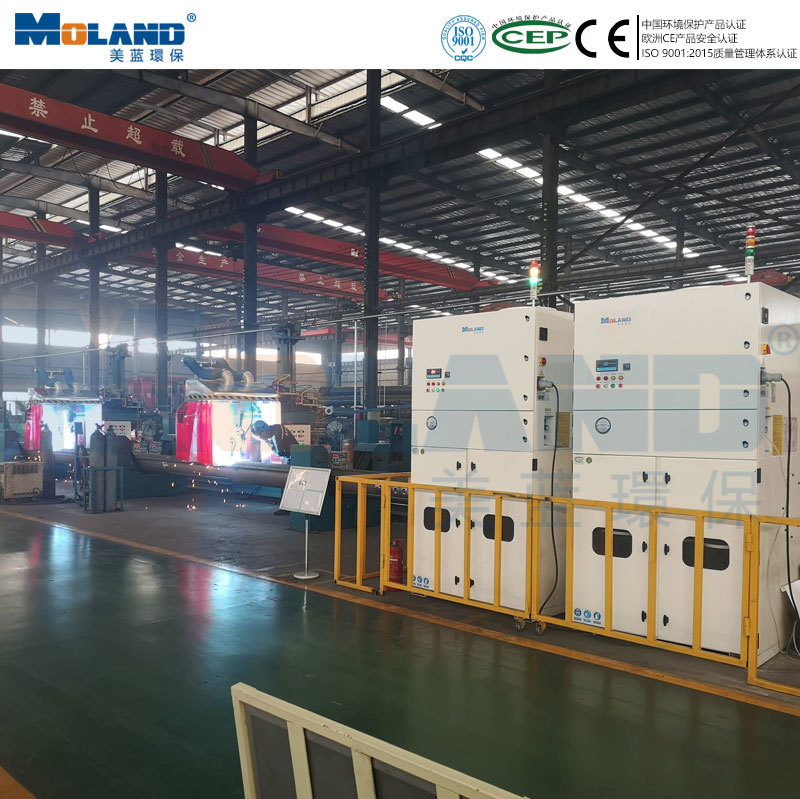
Hood-suction dust collection captures fume by placing an extraction hood — either above, beside, or around the welding zone — and using negative pressure to draw contaminants into the duct system. Specifically, for longitudinal seam welding machines, three hood configurations are most commonly employed.
The overhead enclosure hood is a semi-enclosed or fully enclosed canopy positioned directly above the welding seam. Specifically, the hood extends the full length of the welding travel (or the workpiece rotation zone) and features extraction duct connections at one or both ends. Moreover, the hood's front and rear curtains — typically made of flexible PVC strips or perforated metal plates — contain fume within the capture zone while allowing torch access and workpiece loading.
Key design parameters:
表格
| Parameter | Recommended Value |
|---|---|
| Hood width | Workpiece diameter + 400–600mm |
| Hood height above seam | 300–500mm |
| Face velocity at hood opening | 0.8–1.2 m/s |
| Extraction duct velocity | 12–18 m/s |
| Curtain gap (PVC strip) | 20–30mm overlap |
The overhead enclosure hood is ideal when the workpiece diameter is moderate (up to 1,500mm) and the workshop has sufficient headroom. Specifically, the enclosed canopy provides the highest capture efficiency — typically 90–95% of generated fume — because the hood surrounds the fume source on three sides. Furthermore, the top-down configuration naturally leverages thermal buoyancy, as rising fume is directed into the hood opening.
Key design parameters:
| Parameter | Recommended Value |
|---|---|
| Hood slot width | 150–250mm |
| Hood slot length | Full seam length or segmented |
| Capture velocity at slot | 1.0–1.5 m/s |
| Distance from arc to slot | ≤ 600mm (one-side) or ≤ 1,200mm (two-side) |
| Extraction duct velocity | 14–18 m/s |
The side-draft hood is particularly effective for large-diameter workpieces (above 1,500mm) where an overhead enclosure would be impractically high. Moreover, dual-side extraction — hoods on both sides of the seam — doubles the capture zone and improves efficiency for wide welding configurations. Furthermore, the side-draft configuration allows unrestricted overhead crane access for workpiece loading and unloading.
For heavy-duty longitudinal seam welding — such as thick-wall pressure vessels with multiple SAW torch heads — a combined overhead and side-draft configuration provides the most reliable capture. Specifically, the overhead hood captures the primary thermal plume rising from the arc, while the side-draft hoods intercept residual fume that escapes the overhead enclosure. Consequently, total capture efficiency reaches 95–98%, even under maximum fume generation rates.
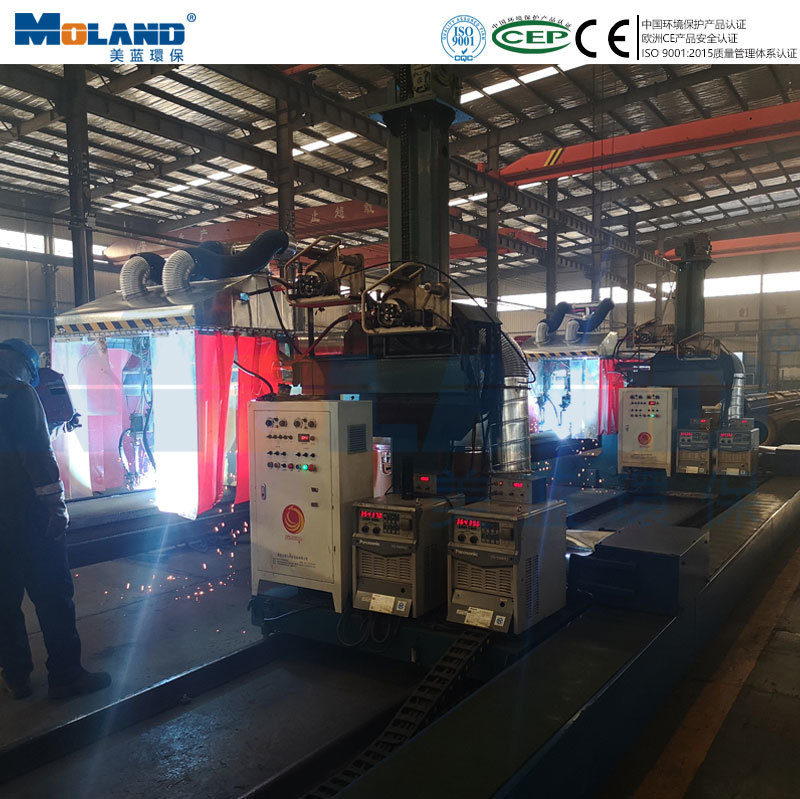
A pressure vessel manufacturer in Hebei Province produces cylindrical storage tanks and heat exchanger shells ranging from 600mm to 2,400mm in diameter, with seam lengths from 2 to 8 meters. Specifically, the facility operates three longitudinal seam welding machines:
Before installing the hood-suction dust collection system, the facility experienced significant challenges:
After on-site evaluation of the three welding machines, workpiece handling patterns, and workshop layout, MoLAND designed a dedicated hood-suction dust collection system for each machine.
For the medium-diameter SAW longitudinal welder, MoLAND installed a full-length overhead enclosure hood. Specifically, the hood spans the entire 5-meter travel length of the welding torch and extends 1.6 meters in width (accommodating the 1,200mm maximum workpiece diameter plus 400mm clearance on each side). Moreover, the hood features PVC strip curtains on the front and rear faces to contain fume while allowing torch access.
表格
| Parameter | Specification |
|---|---|
| Hood Type | Full-length overhead enclosure |
| Hood Length | 5,500mm (full travel + overhang) |
| Hood Width | 1,600mm |
| Hood Height Above Seam | 400mm |
| Curtains | PVC strip, 200mm wide × 600mm long, 25mm overlap |
| Extraction Duct | φ315mm, connected at both ends |
| Design Air Volume | 4,500 m³/h |
| Face Velocity | 1.0 m/s |
| Host Unit | MLWF280FA-PLUS (dedicated) |
| Filter Type | PTFE membrane cartridge |
| Эффективность фильтрации | 99.97% at 0.3μm |
Specifically, this design ensures the hood remains positioned directly above the welding arc throughout the entire seam length. Consequently, capture efficiency remains consistent regardless of torch position.
For the stainless steel tank welder, MoLAND selected a dual-side extraction configuration.
| Parameter | Specification |
|---|---|
| Hood Type | Dual-side lateral extraction |
| Slot Width | 200mm per side |
| Slot Length | 4,200mm (full travel + overhang) |
| Distance from Arc to Slot | 500mm each side |
| Capture Velocity at Slot | 1.2 m/s |
| Extraction Duct | φ250mm per side, merging to φ315mm main |
| Design Air Volume | 3,500 m³/h |
| Host Unit | MLWF281FA-PLUS (dedicated, stainless-steel compatible) |
| Filter Type | PTFE membrane cartridge (stainless-steel grade) |
| Эффективность фильтрации | 99.97% at 0.3μm |
Additionally, the MLWF281FA-PLUS unit features stainless-steel contact surfaces and anti-contamination filter cartridges to prevent cross-contamination between carbon steel and stainless steel operations. Specifically, this prevents iron oxide particles from contaminating stainless steel weld zones — a critical quality requirement for the customer's tank products.
For the large-diameter dual-head SAW machine, MoLAND designed a combined overhead and side-draft configuration. Specifically, the overhead hood covers the upper welding arc (welding the top seam), while two side-draft hoods capture fume from the lower welding arc (welding the bottom seam simultaneously). Moreover, the 2,400mm workpiece diameter makes a pure overhead enclosure impractically large — the combined approach provides efficient capture at a reasonable air volume.
| Parameter | Specification |
|---|---|
| Hood Type | Combined overhead + dual side-draft |
| Overhead Hood | 9,000mm × 2,800mm × 450mm height, φ400mm extraction |
| Side-Draft Hoods | 2 × 8,500mm × 200mm slot, φ315mm extraction each |
| Total Design Air Volume | 8,000 m³/h (4,000 overhead + 2 × 2,000 side) |
| Host Unit | MLWF360 (dedicated, high-volume) |
| Filter Type | PTFE membrane cartridge |
| Эффективность фильтрации | 99.97% at 0.3μm |
| Control | PLC with automatic pulse-jet cleaning |
Furthermore, the system includes a spark arrestor upstream of the filter unit. Specifically, SAW operations occasionally produce sparks and hot slag particles that could damage filter cartridges. Therefore, the centrifugal spark arrestor removes large hot particles before they reach the filtration section, protecting the cartridges and preventing fire risk.
Each hood-suction system is integrated with the welding machine's PLC for automatic synchronized operation. Specifically, when the welding torch initiates the seam weld, the extraction system starts simultaneously. Moreover, a pre-run delay of 5 seconds ensures the airflow stabilizes before the arc reaches full power. Furthermore, a post-run delay of 30 seconds continues extraction after the arc stops, clearing residual fume from the hood. Consequently, operators never need to manually start or stop the dust collection system.
For seams exceeding 4 meters in length, fixed extraction ducts would be too long and create excessive pressure loss. Specifically, MoLAND solved this by mounting the extraction hood on the same gantry as the welding torch. Therefore, the hood travels with the torch along the full seam length, maintaining a constant distance from the arc. Moreover, flexible duct connections — reinforced PVC-coated fabric hoses — bridge the gap between the moving hood and the fixed main duct. Consequently, duct pressure loss remains minimal and consistent throughout the welding cycle.
Pressure vessels and large tanks must be loaded into the welding machine using overhead cranes. Specifically, the hood design accommodates crane access through two approaches. First, overhead enclosure hoods feature removable top panels that can be lifted by crane for workpiece loading. Second, side-draft hoods are mounted at floor level or on adjustable brackets, allowing the overhead crane to pass freely above the workpiece. Consequently, the dust collection system does not interfere with the existing material handling workflow.
MoLAND's engineering team prefabricated all hood structures in the workshop adjacent to the welding machines. Specifically, the overhead enclosure hoods were fabricated from 1.5mm galvanized steel with welded seams and reinforced frames. Moreover, side-draft hoods were constructed from 2.0mm galvanized steel with adjustable slot openings. Furthermore, all hoods were test-fitted before final installation to verify dimensional accuracy.
The main duct network was installed along the workshop ceiling, connecting each machine's extraction point to its dedicated host unit location. Specifically, flexible duct connections were installed at each hood-to-main-duct junction to accommodate hood movement. Moreover, duct diameters were calculated to maintain 12–18 m/s transport velocity throughout the system.
The three host units — MLWF280FA-PLUS, MLWF281FA-PLUS, and MLWF360 — were positioned in the outdoor equipment yard. Specifically, each unit was connected to the 380V power supply, compressed air for pulse cleaning, and the welding machine's PLC for synchronized control. Additionally, the spark arrestor for Machine 3 was installed in the duct between the hood and the MLWF360 unit.
Full-system testing was conducted on each machine. Specifically, MoLAND's engineers measured face velocities at hood openings, duct pressures, and workshop air quality under actual welding conditions. Moreover, each machine was tested with its maximum workpiece diameter and longest seam length. Consequently, all three systems passed the acceptance criteria with capture efficiency exceeding 92% on every configuration.
| Metric | Before | After | Improvement |
|---|---|---|---|
| Workshop respirable dust | 12–18 mg/m³ | 1.2–2.5 mg/m³ | 85% reduction |
| Fume visibility around SAW | < 3 meters | > 15 meters | Fully visible |
| Weld porosity rework rate | 8–12% | 1–2% | 80% reduction |
| Stainless steel contamination incidents | 15 per month | 0 per month | Eliminated |
| Occupational exposure limit compliance | Failed (3–4.5× OEL) | Passed (< 0.5× OEL) | Full compliance |
| Worker health complaints | 10+ per month | 0 per month | Zero complaints |
| Filter replacement frequency | Every 6–8 weeks (old portable) | Every 14–18 months | 10x longer |
The total investment for three hood-suction systems was approximately ¥380,000. Annual savings include:
Total annual savings: ¥505,000+. Payback period: under 10 months.
Longitudinal seam welding generates fume continuously along a predictable straight path. Specifically, hood-suction systems — with hoods that travel with the torch or span the full seam length — maintain constant capture throughout the weld cycle. Moreover, unlike portable extractors that require repositioning, the fixed hood system operates automatically with zero operator intervention.
The hood is positioned above or beside the seam — not in the welding zone itself. Specifically, this placement captures fume effectively without interfering with torch movement, seam tracking sensors, or flux delivery. Furthermore, the hood design allows clear visibility of the welding arc for quality monitoring.
Hood-suction configurations scale across the full range of longitudinal seam welding applications. Specifically, small-diameter tubes (400mm) use simple overhead hoods, while large-diameter vessels (2,400mm+) use combined overhead and side-draft configurations. Moreover, the same filtration technology — PTFE membrane cartridges — serves all configurations, simplifying maintenance and spare parts inventory.
The hood-suction approach works equally well for SAW, MIG, MAG, FCAW, and TIG welding on longitudinal seams. Specifically, the hood captures fume regardless of the welding process — only the air volume and hood dimensions need adjustment. Consequently, workshops with mixed welding processes can use standardized hood designs across multiple machines.
MoLAND designs and manufactures complete hood-suction dust collection systems specifically engineered for longitudinal seam welding machines. Specifically, our solutions include:
Every longitudinal seam welding operation needs fume extraction that matches its continuous, linear welding pattern — without obstructing the process or requiring operator intervention.
Contact MoLAND today for a free on-site assessment and custom hood-suction dust collection design for your seam welding machines.

